October 31, 2026 · Matt Hildreth
In 2024, I Was the Rural Director at Harris Walz. These Are the Trends I’m Monitoring for the 2026 Midterms
By now, everyone knows how much is riding on this election.
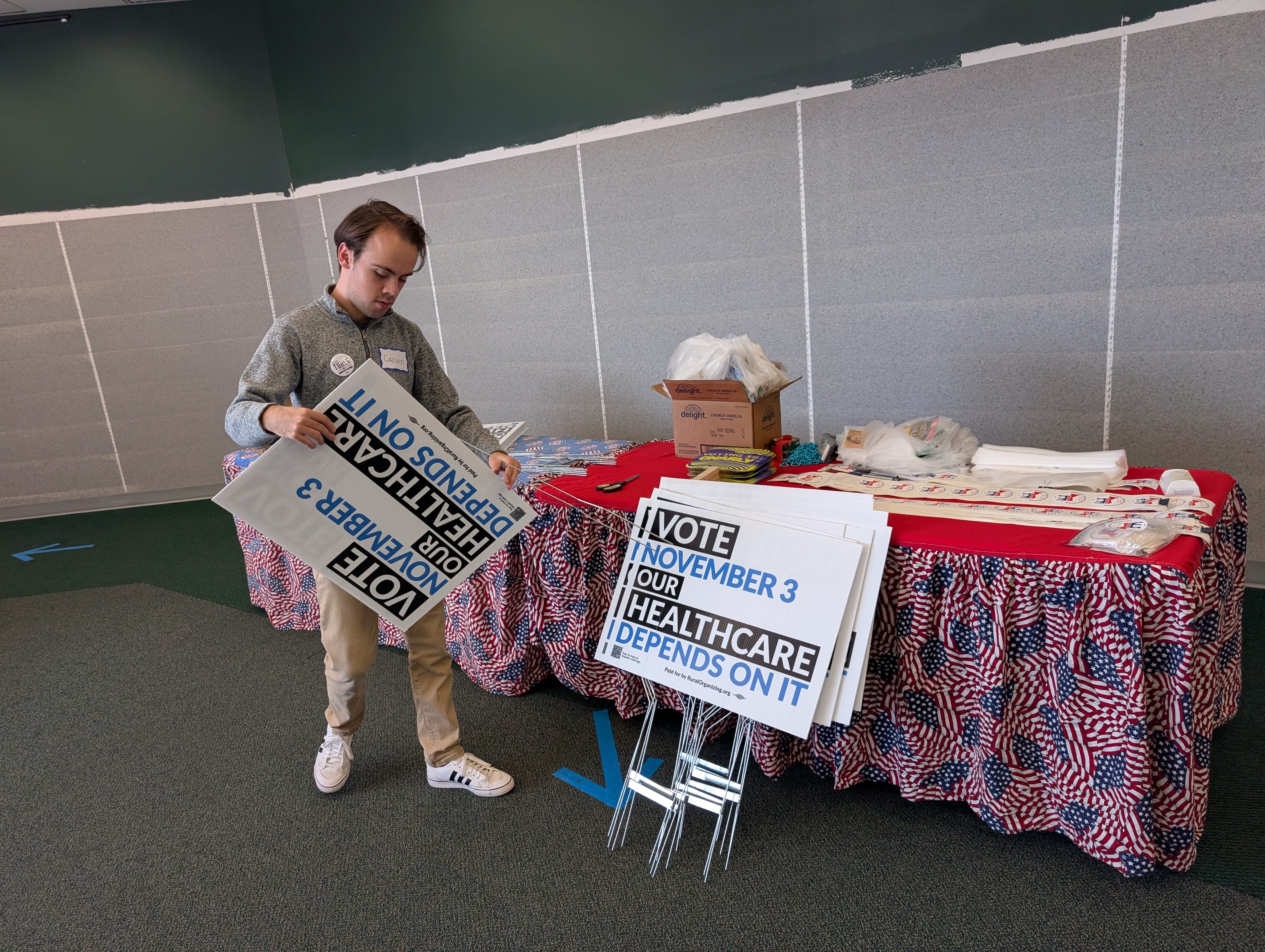
By now, everyone knows how much is riding on this election. Families are paying more for groceries, health care, and electricity while Washington lurches from one round of cost chaos to the next, and the corruption has become almost impossible to keep up with.
Donald Trump heads into Election Day with historically low approval ratings, but that alone won’t hand Democrats a majority. This is still going to be a hard year for Democratic candidates, especially in rural America.
I recently wrote up an in-depth report for The Rural Desk outlining the political trends I’m watching in Rural America. My hope is that this report will highlight just how massive the political shifts need to be in 2026 in order for Democrats to take back the Senate.
But for those who don’t have time to read the in-depth analysis, here’s a quick summary of what I’m watching as Election Day 2026 rapidly approaches.
Democrats are looking strong, even in an incredibly tough year
In recent weeks, pollsters have been bullish on Democrats taking back the Senate.
The latest forecast from FiftyPlusOne, run by a team of former FiveThirtyEight journalists, gives Democrats a 76 in 100 chance of winning the Senate, with a median outcome of 52 Democratic seats.

Their model has Democrats favored in Michigan, Maine, North Carolina, New Hampshire, and Minnesota, and it rates Iowa and Kansas as toss-ups, with Turek and Hamilton holding slight edges.
The path to that majority runs through states Trump carried by double digits.
Still their model has Democrats ahead in:
Alaska (Peltola, 62 in 100)
Ohio (Brown, 61 in 100)
Texas (Talarico, 61 in 100)
And the FiftyPlusOne team gives Democrats a real shot in South Carolina (37 in 100), Nebraska, and Florida (22 in 100 each).
It’s a strong case for why Democratic candidates should feel great heading into election day.
Taking back the Senate is definitely possible this year. If it happens, it will signal one of the biggest political shifts in over two decades. Think back to January of 2025. No one would have envisioned that Democrats would have a shot at taking the Senate. And to be honest, I’m still trying to get my head around the current polls.
While I remain optimistic, with just a few days left in this cycle, we can’t lose sight of how hard the Senate map is for Democrats this cycle.
Every two years, a third of the Senate faces voters, and the third on the ballot Tuesday, Class II, is the most rural of the three by every measure we ran. (You can read my full report here to see how I got to this conclusion.)

That means this year, more than ever, the road to a Senate majority runs straight through small towns, rural communities, and farm country.
In the 33 Class II Senate states, 18.2% of people live in non-metro counties (RUCC 4–9), compared to 13.8% in the United States as a whole and 11.3% and 13.4% in the other two Senate classes. Sixteen of those states are at least one-quarter non-metro. Only 19 of the 50 states are, so 16 of the 19 have a Senate race this year.
That’s what the national numbers miss. A generic-ballot poll or a Trump approval rating samples the country as a whole, where about 14 percent of people live in non-metro counties.
But the Senate counts states, not people, and this year’s states are far more rural: in the average Class II state, more than a quarter of residents (26.5%) live in non-metro counties. To win the majority, Democrats need to win 17 of the 35 races on the ballot (the 33 regular Class II races plus special elections in Ohio and Florida).

Line those states up by the 2024 presidential vote, and the 17th-best state for Democrats is Alaska, which Trump carried by about 13 points while winning the national popular vote by just 1.5.
In other words, the seat that decides the majority sits about 11 points to the right of the country as a whole. A national environment that looks unprecedented for Democrats can still leave them short in the Senate.
To Take The Senate, Democrats Need An Historic Performance in Rural America
Democrats can win the House in metro America. If every metro county (RUCC 1–3) returned to its 2008 margin, Democrats would win about 230 House seats, even if non-metro counties did not move at all. They cannot win the Senate with this strategy.
Metro gains alone would give Democrats 48 seats. Obama’s 2008 margins in every county produce a 50–50 Senate, with Vice President JD Vance breaking the tie.

Here’s what makes this year so hard for me to call. Eight Senate races are separated by less than four points in the polling averages, about the margin of error of a single poll. In Kansas, the Democrat leads by two-tenths of a point. Iowa is a half-point race. Alaska, Maine, Texas, Ohio, South Carolina and Michigan are all within about three points. Most of them are in states where rural voters carry real weight: about four in ten Mainers and Iowans live in non-metro counties, and so do about a third of Alaskans and three in ten Kansans.
But like forecasters, I still like Democrats’ chances. The FiftyPlusOne model gives Republicans about a one-in-four chance of holding the Senate.
Still. We can’t ignore the 25%. One in four is still a pretty good shot, and with this many races this close, it doesn’t take much for Republicans to get there.
A two-point polling miss isn’t a crazy idea. In 2020, Susan Collins trailed in nearly every public poll in Maine and won by almost nine points. So the honest read on this Senate map is that Democrats are now favored but nowhere near safe. Their majority depends on a handful of mostly rural states where the polls are close enough that the people who decide them haven’t fully shown up in the polling yet.
Winning a 51st Senate seat will take a rural result better than any Democrat has managed since at least 2008, Obama included. Non-metro counties have to come in near R+11 across the board—contrast that with Harris’s R+36 and Obama ‘08’s R+13. A shift that large would be more historic than Trump’s rural wave in 2016.

Everything changed in 2016. Democrats went from R+19 in non-metro counties in 2012 to R+34 in 2016, and no Democrat has climbed back since. The Senate number we need is better than even Obama’s first race. No Democrat has cleared that bar in at least 18 years.
2026 Could Be An Historic Year for Democratic Candidates
Since 2008, Democrats have done better in a midterm than in the presidential year before it only once: 2018, the one midterm with Trump in the White House. And even then, Democrats still only won a majority of the House.
This year again, a 2018-sized swing won’t flip the Senate. Our scenarios need non-metro (RUCC 4–9) counties to swing about 25 points from Harris’s margin. A national swing like 2018’s is well under half of that, so Democrats would need rural counties to swing far more than the country does.
That’s why the Senate even just being in play this cycle is so historic.
Look at Maine, a must-win state for Senate Democrats. In the October 22 Fox News Poll, Collins leads rural voters by 7 points, while Democrat Troy Jackson leads the smaller group of suburban voters by 18 points.
For comparison, in 2020, Collins won both the voters living in rural areas and those without a college degree by 18 points each. Remember, Joe Biden won the state by nine that year. That’s a gap of about 18 points between her and the top of her own party’s ticket. Today the polls show that crossover vote down to five or six points, and the drop is concentrated in rural Maine, where Collins built her 2020 win.
“Republicans appear to be struggling with White rural voters this cycle, and Maine is no exception,” said Daron Shaw, the Republican co-director of the Fox News Poll. “GOP candidates desperately need these voters to show up, and need something like a 65-35 vote to overcome Democratic strength in urban areas.”
In other words, Collins hasn’t been this beatable in a long time and it’s because Jackson is cutting down her rural margins.
Local Democrats Have Spent A Decade Preparing for Election Day
There’s no doubt about it. The math is hard for Democrats this year. Taking back the Senate is a massive challenge, and it means doing better in rural America than any Democrat has since 2008.
The map is hard, but local Democrats are ready for it. They have spent the last ten years building back, and they are better organized now than at any point since the early 2000s. That strength comes from county parties that meet all year, from neighbors who run for school board and county commission, and from people who knock doors in towns where everyone knows their name.
All across the country we’ve met hundreds of vocal locals working day and night to elect candidates who will put an end to the extraordinary costs, chaos, and corruption we’re seeing from MAGA Republicans.
And that’s why I’m cautiously optimistic. And when the results come in, we need to celebrate cutting margins in rural America just as much as we celebrate the counties, and chambers, that flip.
Originally published on Substack. Comments and discussion happen there.
Newsletter
Subscribe to Field Notes
Field reports, rural campaign analysis, and dispatches for the candidates and causes building rural power. Free, straight to your inbox.